

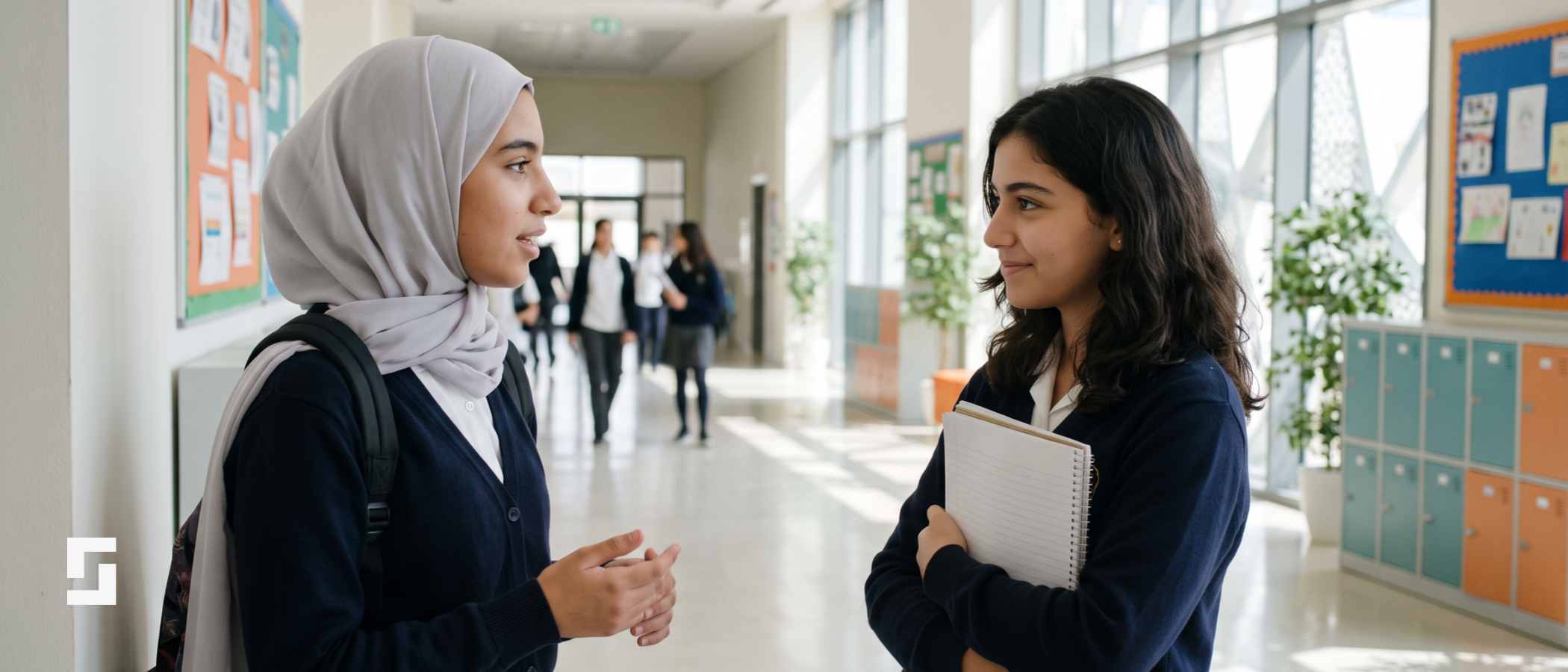
Most of the moments that shape how students treat each other happen in passing. This article looks at what the research says about practising social and emotional skills before those moments arrive, and how schools can follow that growth over time.
A student is left out of a conversation at break. Another hears something hurtful and has about two seconds to decide how to answer. A third sees a classmate struggling and wonders whether it is their place to say anything.
None of this is likely to reach a behaviour report or a parents’ evening. Yet these small moments shape how students treat each other, and how they come to see themselves. Each one asks for a choice, and each choice is a chance to practise a skill.
Schools are good at supporting students once something has gone wrong. The harder question is what happens earlier: how do students build the skills they will need before those moments arrive?
Skills are built before they are needed
When a student faces bullying, distress or conflict, they need trusted adults and clear processes. That support will always matter. But the ability to name a feeling, read a situation or hold back a sharp reply is learned well before the day it is needed, and it is learned through repetition.
Regular practice gives students a place to recognise emotions, understand other people, manage their reactions, build relationships and think through the consequences of what they do. Nobody expects them to get it right every time. The aim is steadier judgement, built slowly. And it is for every student, because every student will meet situations that call for empathy, self-control, honest communication and a sensible decision.
What the research shows
There is a substantial body of research on school-based social and emotional learning, and it points in a consistent direction.
In 2023, a meta-analysis in Child Development brought together 424 studies from 53 countries, covering 575,361 students. Students who took part in universal school-based social and emotional learning programmes did better than control groups on social-emotional skills, behaviour, peer relationships, school functioning and academic achievement [1]. The authors were careful to add that results varied with programme content, context and how well the programme was implemented.
That finding builds on an earlier landmark review from 2011, which looked at 213 studies and more than 270,000 students and found gains in social and emotional skills, attitudes, behaviour and academic performance [2].
Neither study claims that every programme works equally well, or that structured learning can stand in for individual support. What they do show is that these skills are worth teaching on purpose rather than leaving to chance.
Why advice alone falls short

Students hear plenty of advice. Be kind. Respect others. Stay calm. Make good choices. Most of them could repeat it back to you word for word. The trouble is that advice is given in calm moments, and skills are needed in the other kind.
Go back to the student who was left out at break, and think about the friend they tell afterwards. That friend might change the subject, jump in with advice, or stop and simply listen. Each response says something different. Thinking through those options before it happens for real helps a student consider how the other person feels, notice the effect of their own words and imagine what they might do differently.
This is why active learning matters. CASEL describes effective social and emotional learning instruction as sequenced, active, focused and explicit: skills developed deliberately, through connected opportunities to practise, rather than through the occasional reminder [3]. A scenario cannot recreate every pressure of a real moment. It can, however, give students room to think before they face something similar in their own lives.
Relationships do part of the teaching
Students do not learn these skills alone. They learn them in classrooms, corridors and friendships, which means the school environment counts.
The US Centers for Disease Control and Prevention (CDC) identifies school connectedness as an important protective factor. Students who feel that adults and peers care about them, value them and support their learning are less likely to experience a range of harmful outcomes [4]. The CDC also points to practices that build relationships, empathy and trust, and to approaches for repairing relationships when conflict happens [4].
Everyday skill-building and individual support work together. Students need regular chances to build good relationships, and they need trusted adults to turn to when things get difficult. A school that offers both gives them far more to stand on.
Growth takes years to see
A student may show real empathy on Monday and struggle to find it on Thursday. They may recognise exactly what they are feeling and still not manage their response. They may know a friend needs help and hesitate anyway. Growth in these areas is uneven, and one activity, one assessment or one conversation will never tell the whole story.
Schools need ways to come back to the same skills in different situations and to notice patterns as they form. The Education Endowment Foundation (EEF) stresses careful implementation, and the value of combining approaches for all students with extra support for those who need it [5]. Its evidence review draws on studies in both primary and secondary schools.
For school leaders, that changes the question. It is no longer only whether a programme was delivered, but whether the school understands how each student is developing across the years, rather than simply recording participation at the end of term.
Following growth is not about labelling students or reducing them to a score. It means bringing together sound information, professional judgement and good relationships to see where skills are taking hold and where a little more guidance would help.
Where AnaAkhtar fits
This thinking shaped AnaAkhtar, an Arabic-first bilingual platform that helps schools strengthen and follow students’ social, emotional and behavioural development from Grade 4 to Grade 12.
Each year, students work through 32 real-life experiences built around situations they are likely to recognise. They watch, choose, reflect and revisit. Along the way they practise the five CASEL competencies (Self-Awareness, Self-Management, Social Awareness, Relationship Skills and Responsible Decision-Making), together with AnaAkhtar’s sixth competency, Community & Civic Responsibility.
Where those situations come from matters too. Students across the MENA region meet them in Arabic first, with English alongside, set in the school and family life they know. It is easier to practise a choice when the moment on screen looks like your own.
Parents receive guidance so they can support the same journey at home. School Supervisors follow each student’s growth and see patterns as they emerge, and institution leaders can view aggregated trends across schools and cohorts.
AnaAkhtar does not replace teachers, counsellors or the relationships that hold students up. It gives schools a steady, continuous way to build skills alongside the care they already provide. The research above supports the principles behind it: regular practice, reflection, supportive relationships and continuity. AnaAkhtar’s own impact should be judged through its implementation and evaluation, not assumed from studies of other programmes.
The moment before
Think again of the three students at the start: the one left out, the one about to answer back, the one wondering whether to step in. Whatever they choose will rarely make it into a school report. It still matters, and so does the practice that came before it.
Building skills for life means giving students repeated chances to practise, reflect and learn before they need those skills somewhere unfamiliar. The question for schools is not only how well they respond when something goes wrong, but how consistently they prepare students for the moments that come first.
Research & References
Selected research and practical guidance for educators. Numbered references correspond to citations in the article.
1. Cipriano et al. (2023): Child Development
Contemporary meta-analysis: 424 studies, 53 countries, 575,361 students. Read source
2. Durlak et al. (2011): Child Development
Foundational meta-analysis: 213 studies and 270,034 students. Read source
3. CASEL: Explicit SEL Instruction
Practical guidance on sequenced, active, focused and explicit instruction. Read source
4. CDC: Restorative Practices and School Connectedness
Guidance on building relationships and repairing harm. Read source
5. Education Endowment Foundation: Social and Emotional Learning
Evidence overview for educators, including implementation considerations. Read source
By: AnaAkhtar
